

Dedicated Server vs Peer to Peer Which Multiplayer Model Is Best for Your Game?
Choosing the right multiplayer networking architecture affects your game’s performance, security, scalability, and development costs. Understanding dedicated server vs peer to peer networking helps game developers select an approach that matches their gameplay mechanics, target audience, and technical requirements.
Dedicated servers, peer-to-peer connections, and relay-based networking each solve different multiplayer challenges. Whether you are building a competitive shooter, a casual co-op game, or a real-time strategy experience, comparing these models helps you create smoother multiplayer sessions and a more reliable player experience.
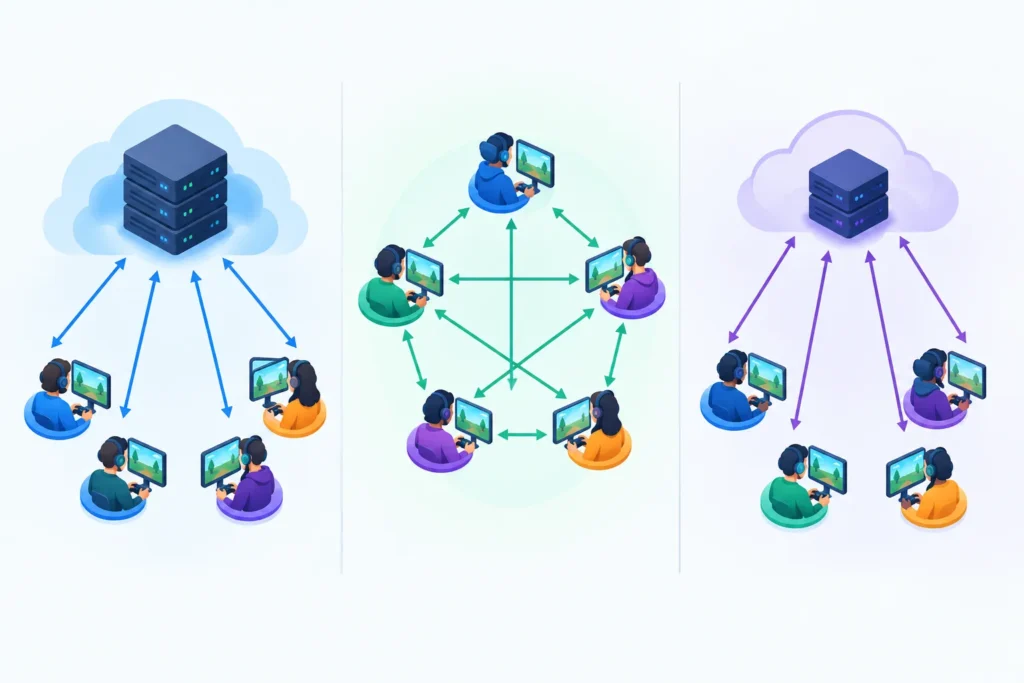
Understanding the Three Multiplayer Networking Models
Multiplayer games exchange information about player movement, actions, game state, and session events. The networking architecture determines how that information travels between participants and which system coordinates the gameplay.
Each model offers different advantages depending on player count, competitive requirements, connection quality, and infrastructure budget.
Dedicated Server Networking
A dedicated server runs game logic independently of individual players, providing centralized state management, authoritative gameplay, and consistent control over multiplayer sessions.
Peer-to-Peer Networking
Peer-to-peer networking allows players’ devices to communicate directly or coordinate through a selected host, potentially reducing infrastructure requirements for suitable games.
Relay-Based Networking
Relay networking routes multiplayer traffic through an intermediary service, helping players connect when direct connections are difficult and reducing exposure of their IP addresses to other players.
Hybrid Multiplayer Architecture
Hybrid architectures combine approaches, such as dedicated servers for authoritative gameplay and relays for connectivity, to balance security, reliability, and networking flexibility.
Dedicated Server vs Peer to Peer vs Relay
When evaluating dedicated server vs peer to peer networking, consider how each architecture handles game authority, connection reliability, cheating risks, and ongoing operating costs. A dedicated server processes authoritative game state on infrastructure controlled by the developer or hosting provider. This approach is often suitable for competitive shooters, persistent worlds, battle royale games, and large multiplayer experiences. It offers greater control over validation, matchmaking integration, and server-side anti-cheat systems, although it introduces hosting and maintenance expenses.
Peer-to-peer networking allows participating devices to exchange game data directly or through a designated player acting as host. It can reduce dedicated infrastructure costs and work well for small co-op games, party games, and certain turn-based experiences. However, host disconnections, differences in network quality, and the difficulty of enforcing trusted game state can create challenges. Relay networking forwards traffic through an intermediary rather than requiring every player to establish a direct connection. It can improve connectivity across restrictive networks and help conceal player IP addresses from other participants. A relay does not automatically provide authoritative game simulation or prevent cheating; those capabilities depend on the broader architecture.
How to Choose the Right Multiplayer Model
The best networking model depends on your game’s competitive level, session size, expected traffic, and infrastructure budget. Evaluate the following factors before selecting a multiplayer architecture.
Competitive gameplay
Choose authoritative dedicated servers when fairness, server-side validation, and consistent game-state control are critical to the experience.
Casual cooperative games
Consider peer-to-peer networking for small groups when lower infrastructure costs outweigh potential host migration and connection reliability challenges.
Connectivity and privacy
Use relay networking when direct connections frequently fail or when you want to avoid exposing player IP addresses to other participants.
Six Factors to HMAC-Compare Before Making Your Decision
Performance and latency
Direct peer connections can provide low latency between nearby players, while dedicated servers offer predictable routing when server locations are selected appropriately.
Security and cheating
Dedicated servers can validate critical actions centrally, whereas peer-hosted games may expose greater opportunities for manipulation unless additional safeguards are implemented.
Infrastructure costs
Peer-to-peer models may reduce server expenses, while dedicated servers and relays introduce operational costs that depend on traffic and provider pricing.
Scalability and player count
Dedicated server infrastructure supports controlled scaling across sessions, while peer-to-peer architectures can become difficult to manage as participant counts increase.
Connection reliability
Relays can help players connect through restrictive networks, while dedicated servers provide managed endpoints; neither guarantees low latency or uninterrupted connectivity.
Game design requirements
Fast competitive shooters often benefit from authoritative servers, while smaller cooperative games may prioritize simple connectivity, lower operating costs, and easier session management.
Frequently Asked Questions
Dedicated servers are generally preferable for competitive games requiring authoritative game state, centralized validation, and predictable administration. Peer-to-peer can suit smaller cooperative games with simpler requirements.
Relay networking routes game traffic through an intermediary service. It can help players connect across restrictive networks and conceal their IP addresses from other participants.
Peer-to-peer can have lower dedicated infrastructure costs, especially for small games. However, relays and dedicated servers may offer reliability or security benefits that justify their operating costs.